Hammurabi Inc.
2026-05-05
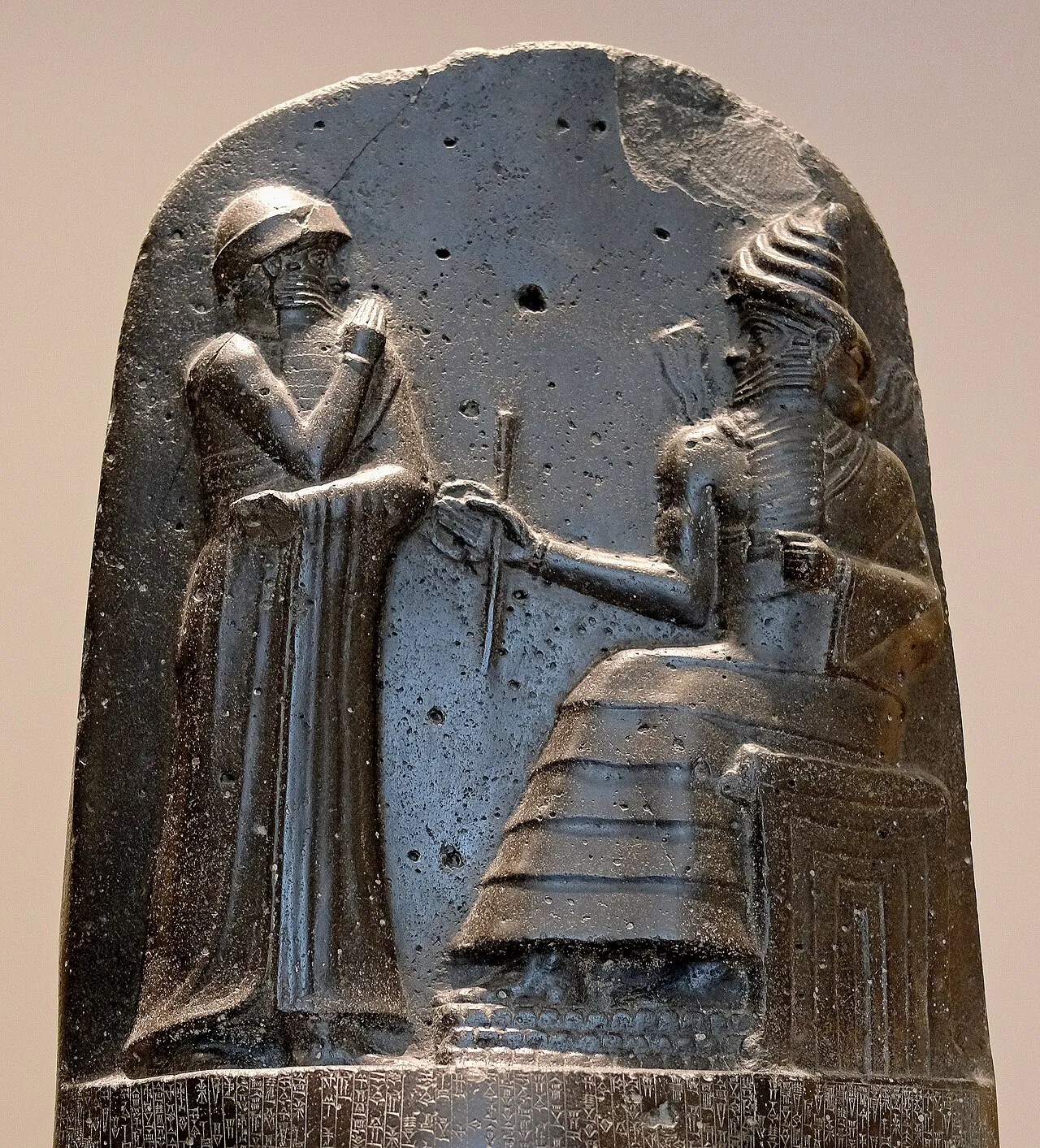
Read the API terms of any frontier LLM company. Output is provided “as-is” and “for informational purposes only.” All warranties are disclaimed. The customer indemnifies the company against any claim arising from use of the model. It reads like boilerplate but it is the economic precondition for the token to be sold for fractions of a cent to hundreds of millions of users a day. A token comes with no signature attached. No one signs the diagnosis, the audit, the engineering drawing. The model produces all of them and underwrites none of them.
Hammurabi’s code, the oldest surface of human law we still have, wrote the rule four thousand years ago: a builder whose house collapsed and killed its owner was himself put to death. The structural engineer stamps a drawing and goes to prison if the building falls; the stamp is what makes the drawing worth paying for, because someone’s freedom is now tied to every load calculation inside it. Ghostwriters and committee reports have carried unsigned cognition for centuries, but always at the cost of a named mind and within a single domain. LLMs are the first near-zero marginal cost producer of generalized unsigned cognition: a single architecture that generates text across every domain and underwrites none of it. The generality and the cost are what make the disclaim possible, and the disclaim is what makes the price work.
Three company shapes survive the shift. Sources produce raw unsigned cognition at commodity prices, disclaim everything, and race to zero margins. Editors own the surface between the user and the source in a specific domain (the observability layer, the payments layer, the dev environment) and shape what flows through it with accumulated judgment that costs years to replicate. Publishers put their name on the output and accept the liability: regulatory exposure, fiduciary duty, a license that can be revoked. Everything else is a content mill: unsigned cognition with extra steps and no editorial surface worth the name. The sources price the extra steps to zero.
The litmus test is two questions. Hand a competent team a frontier coding agent and a quarter of runway. Can they reproduce the product? If yes, the company was a content mill. If they can rebuild the software but not the editorial surface, the accumulated judgment about what to show, what to suppress, how to interpret, the company is an editor. If they cannot enter the category at all without accepting liability the disclaim forbids, the company is a publisher.
The interesting questions are not which bin a company sits in today but which direction the boundaries are moving.
When the Source Absorbs the Editor
Platforms with a profitable core commoditize their adjacencies; anything charging margin between the user and the core dies. Google released Android as open source and gave it to every handset maker for free, not to profit from the OS but to keep Search as the default on every phone. By 2013, Android ran on 80% of smartphones sold worldwide, and the margins of every mobile software company sitting between user and search compressed toward zero.
The sources are running this play one floor up. They price everything between the user and the model toward zero: coding assistants, search, translation, document analysis, customer support tooling. They do not need to win those categories; they need to make them cheap enough that no one can charge a margin on top of inference. Every editorial surface a source absorbs is one fewer surface an independent editor can own.
What makes a surface absorbable is generality. Search, translation, and code completion are generic enough that a horizontal source can do them well without specializing. What makes a surface resistant is the density of accumulated domain opinion: the alerting thresholds Datadog has calibrated across thousands of production environments, the fraud-detection heuristics Stripe has tuned against billions of transactions. A source cannot replicate that judgment without specializing in the domain, and specializing in a domain means accepting domain-specific obligations that break the horizontal disclaim. The source stays general or it stops being a source.
When the Editor Becomes a Publisher
The second transition is harder and more valuable. An editor that accepts liability for its output crosses into publishing: its moat shifts from accumulated opinion (which erodes as agents improve) to a signature (which does not erode because the barrier is legal, not technical).
Brand alone does not make the crossing. Brand is reputation without exposure; no one’s license is revoked when the anomaly detection misses or the coding agent ships a vulnerability. An editor with a strong brand and no liability is still an editor, and the source is still pushing inward. The crossing happens when the editor starts guaranteeing outcomes: Datadog accepting financial exposure for missed incidents, Stripe indemnifying merchants against fraud it should have caught, a coding platform warranting that its output is free of IP infringement. At that point the cost structure changes overnight, and the editor competes with incumbents who have held signatures for decades. The crossing is expensive; the alternative is to wait for the source to absorb you.
The same logic applies in reverse. Some sources will eventually reach for the last mile by accepting verticalized liability: a medical AI with malpractice insurance, a lab that indemnifies against misdiagnosis. At that point the source stops being a source in that vertical and becomes a publisher, trading the disclaim for a margin structure that can sustain a business. Watch for the first lab that accepts a malpractice premium.
The Content Mill
A company in the dead zone has neither an editorial surface nor a publisher’s liability. It sells unsigned cognition with a UI on top and calls it a product. The litmus test returns a yes in under a quarter.
The only question is which direction to run. Run toward editing: own a domain’s context deeply enough that the accumulated judgment costs more to replicate than the subscription costs to renew. Run toward publishing: accept liability the disclaim forbids, convert trust into legal exposure, and build a moat the sources cannot cross without ceasing to be sources. Stand still: get priced to zero.
Anything that terminates inside one company collapses to a prompt: internal CRMs, dashboards, project trackers, ETL glue, ops runbooks, all regenerated by whichever team needs them, often overnight, because no signature is required and no editorial surface is at stake. The outside of the firm, where it meets other firms, regulators, and history, does not collapse, because that is where the signatures live.
The Builder’s Rule
The requirement that someone answer for the output does not go away because cognition gets cheap; cheap cognition makes the named human more valuable, because the volume of decisions goes up and the volume of consequences goes up with it. The sources cannot become that person, by structure, without giving up the disclaim that makes the price work. The builder’s rule has held for four thousand years. The API disclaim is the first serious attempt to route around it, and the question every company should be asking is not which bin it sits in but which direction it is running.