Signed Cognition
2026-05-05
Read the API terms of any frontier LLM company. Output is provided “as-is” and “for informational purposes only.” All warranties are disclaimed. The customer indemnifies the company against any claim arising from use of the model. It reads like boilerplate but it is the economic precondition for the token to be sold for fractions of a cent to hundreds of millions of users a day. A token comes with no signature attached. No one signs the diagnosis, the audit, the engineering drawing. The model produces all of them and underwrites none of them.
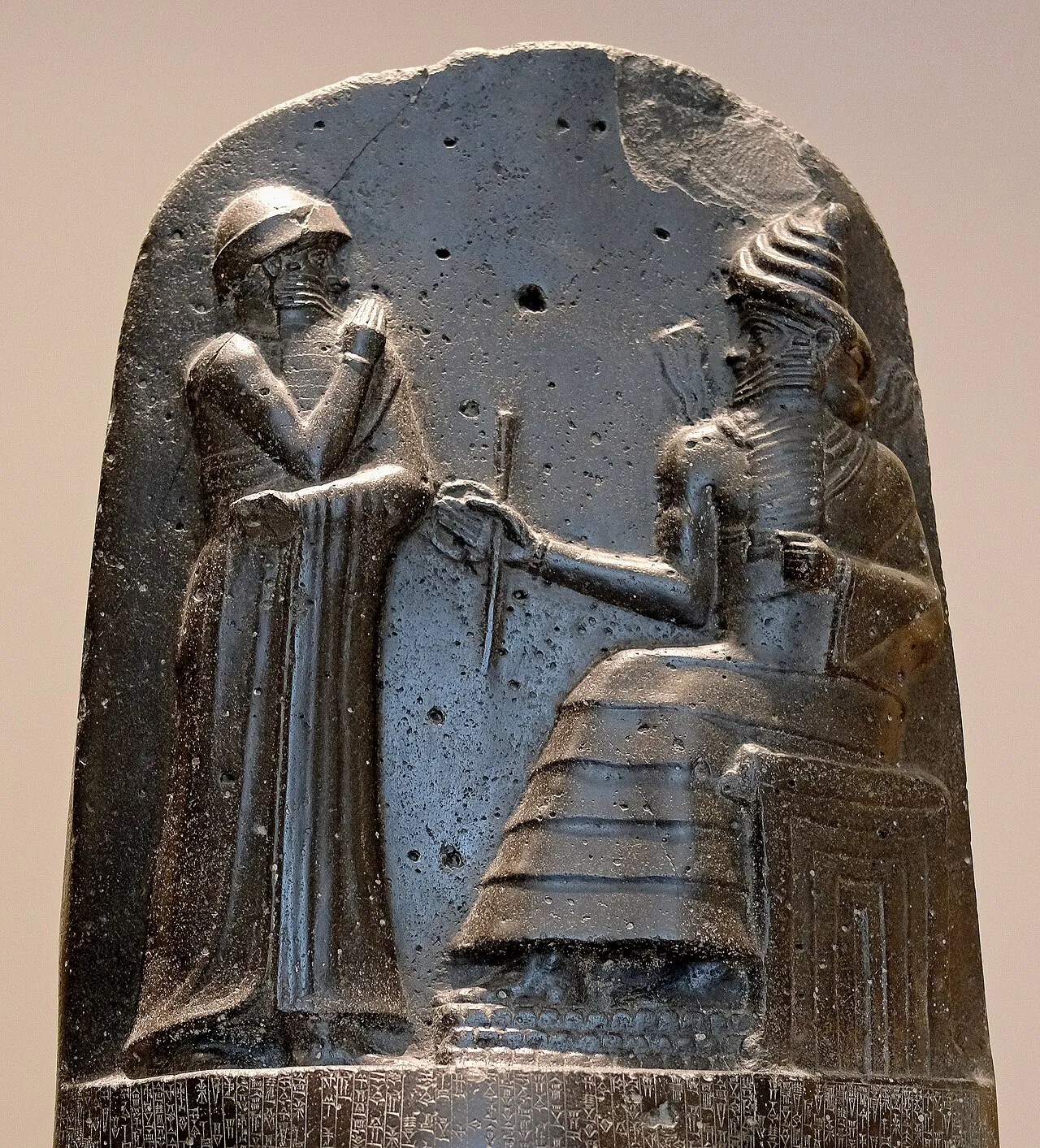
Hammurabi’s code, the oldest surface of human law we still have, wrote the rule four thousand years ago: a builder whose house collapsed and killed its owner was himself put to death. Every form of paid cognition since has carried the same structure. A structural engineer stamps a drawing and goes to prison if the building falls; the stamp is what makes the drawing worth paying for, because someone’s freedom is now tied to every load calculation inside it. The doctor’s signature, the auditor’s seal, the journalist’s byline all do the same work: they attach a career, a license, or a liberty to the output. Tokens are the first form of paid cognition in recorded history that carries none of that. The absence is what makes the price possible.
Two company shapes survive the shift. Token utilities generate unsigned cognition by the trillion, win on capex and distribution, and consolidate to a handful of global players. Underwriters sell intelligence applied to something a model cannot sign for. The middle, what we currently call SaaS, traffics in unsigned cognition with extra steps. The utilities price the extra steps to zero.
What a Signature Is
An underwriter holds at least one signature a model cannot assume. There are four kinds. Signed atoms: regulated physical operations where the state requires a named human with personal exposure, like a pharma QA director signing every batch release under criminal liability. Signed relationships: fiduciary ties built over decades that transfer slowly, like a bank holding trillions in client assets. Pure attestation: a regulated entity’s willingness to be sued if the analysis was wrong, like an audit partner whose name is on a 10-K under PCAOB inspection. Signed context: a proprietary archive whose custodians face criminal exposure for breach, like a hospital’s HIPAA Security Officer who can get ten years for wrongful disclosure of patient records.
Signatures stack. A semiconductor fab has dozens of named officers across export controls, OSHA, and customer audits, each one a year of compliance work that a competitor would have to replicate from scratch. A coffee shop has a food handler permit. Both are signers; the fab took decades to assemble and the coffee shop took an afternoon. “We own warehouses” usually fails the same test: the atoms are real, the signatures are shallow, and the operation is reproducible by anyone with capital.
The structural test for any company: hand a competent in-house team a frontier coding agent and a quarter of runway. Can they reproduce the product? If yes, the product was the middle.
Scorched Adjacencies
The mechanism is older than AI. Platforms with a profitable core commoditize their adjacencies, and anything charging margin between the user and the core dies. Google released Android as open source and gave it to every handset manufacturer who wanted it; Google did not need to profit from the OS, it needed the OS on every phone so that Search stayed the default. By 2013, Android ran on 80% of smartphones sold worldwide, and the margins of every mobile software company sitting between user and search compressed toward zero.
The token utilities are running this play one floor up. They price everything between the user and the model toward zero: coding assistants, search, translation, document analysis, customer support tooling. They do not need to win those categories; they need to make them cheap enough that no SaaS company can charge a margin on top of inference.
What they cannot price to zero is the signature. A coding agent will rebuild a project tracker in a weekend; it will not sit for the FAA’s airworthiness exam, hold a state medical license, or accept fiduciary duty under ERISA. The categories that survive are the ones the utilities are legally not allowed to enter without giving up the disclaim language that makes the price work. The day a frontier lab indemnifies a hospital against a misdiagnosis, the lab stops being a token utility in that vertical and becomes a medical-device company. Its margin structure changes overnight.
Anything that terminates inside one company collapses to a prompt: internal CRMs, dashboards, project trackers, ETL glue, ops runbooks, all regenerated by whichever team needs them, often overnight, because no signature is required. The outside of the firm, where it meets other firms, regulators, and history, does not collapse, because that is where the signatures live.
There is a Christensen corollary here. When the technology is “not good enough,” the winning architecture is integrated; when it overshoots, the architecture goes modular. AI shifted where “not good enough” lives. Building the software used to be the bottleneck, so companies bought SaaS modules that were each good enough at one slice. Now that building software is cheap, the bottleneck moves to the judgment, context, and accountability that surround it. The integrated player is no longer the SaaS vendor; it is the small team that owns the full loop from decision to consequence, generating its own tools overnight and hiring generalists who control end-to-end rather than specialists who slot into one vendor-shaped workflow.
Every Surface
The adjacency-scorching will not stop at coding assistants and search. A utility has no reason to leave any token-generating surface in someone else’s hands. Chrome exists because Google needed every browser’s default search to be Google. The lab browser will exist for the same reason: whoever owns the surface where reasoning happens owns the billing meter for every token that flows through it. Expect at least one major utility to ship a browser by 2027 and offer git hosting at or below cost in the same window.
Follow the logic one step further and the utility becomes the literal operating system. Apple already ships on-device models. Google already runs Gemini inside Android. Within a decade the traditional OS is a legacy compatibility layer, and the primary interface is a model runtime that holds the full context of everything you do on the device. The token is the new instruction set; the lab is the new Intel, the new Microsoft, the platform on which everything else runs.
Apply the framework to that endgame and it gets uncomfortable. Brand has always been a signature of sorts: a name staked on consistency, decades to compound, destroyed in a news cycle. Unsigned cognition flooding every surface may make brand more valuable as a trust heuristic, not less; the consumer needs a prior, and a trusted name is the fastest one available. But brand alone is a reputation without exposure. A company that holds all your telemetry or has tuned its models against millions of codebases may effectively become your operating system, but an operating system is not a signature; no one’s license is revoked when the anomaly detection misses or the agent ships a vulnerability. Hyper-personalized interfaces dissolve the shared surface where consistency was visible; there is no shared product to be loyal to, just small shallow ponds of one. The brands that endure will be the ones that convert trust into liability, not the ones that assume trust alone is enough.
The exception worth flagging is what happens when a utility decides to underwrite. The horizontal token layer is a race to zero: utilities competing on price, latency, and scale, with margins compressing the way electricity margins do. The last mile, where the token meets a regulated decision and someone has to sign for the outcome, is where the margin lives. Some labs will eventually reach for it by accepting verticalized liability: a medical AI with malpractice insurance, a coding agent that indemnifies against IP infringement. At that point the lab stops being a utility in that vertical and becomes an underwriter, trading the disclaim for a margin structure that can actually sustain a business. The economics of the disclaim do not permit this at the horizontal layer; they may permit it at the vertical. Watch for the first lab that accepts a malpractice premium.
The Builder’s Rule
Token utilities win at the bottom, underwriters win above them, and the top layer is disposable, rebuilt per-firm, often overnight. Whether two or three lab-platforms own the runtime the way Microsoft owned the desktop, or open-source models close the gap and commoditize the token layer entirely, remains an open question. Open-source weights keep improving; frontier labs keep scorching adjacencies to stay sticky, bundling enough complements (browsers, agents, storage, identity) that the switching cost compounds even if the raw model quality converges. The pattern is Microsoft in the 1990s: the OS margin funded free Internet Explorer, free Outlook Express, free Media Player, until the stack was too entangled to leave. If frontier labs run the same play, the moat is the bundle, not the model. If open-source catches up fast enough, the token layer commoditizes and the only durable margin lives in the signature.
The requirement that someone answer for the output does not go away because cognition gets cheap; cheap cognition makes the named human more valuable, because the volume of decisions goes up and the volume of consequences goes up with it. The token utilities cannot become that person, by structure, without giving up the disclaim language that makes the price work. The builder’s rule has held for four thousand years. The API disclaim is the first serious attempt to route around it, and the question every company should be asking is whether they are the builder or the stone.